English
 中文简体
中文简体How Strong Are Double-Layer Paper Cups for Hot Drinks?
Content
- 1 The Engineering Behind Double-Layer Paper Cup Strength
- 2 Strength and Performance Comparison: Double-Wall vs. Single-Wall vs. Ripple Cups
- 3 How Heat Affects Structural Integrity Over Time
- 4 Thermal Performance Retention Over Time
- 5 Eco Friendly Double Layer Paper Cups: Sustainability Without Compromising Strength
- 6 Custom Printed Double Wall Paper Cups: Structural Considerations for Branded Production
- 7 Double-Wall Paper Cup Market Growth (2020–2026)
- 8 Quality Standards and Testing for Double-Wall Paper Cups
- 9 Frequently Asked Questions
Double-layer paper cups are significantly stronger than single-wall cups for hot drinks — typically withstanding 30–50% more radial compression force before deforming, maintaining structural integrity with beverages up to 95°C (203°F), and staying comfortable to hold for 3–5 times longer due to the insulating air gap between walls. A quality double-wall cup filled with boiling coffee will not require a sleeve, will not buckle under a firm one-handed grip, and retains its shape throughout a normal drinking session. This article breaks down exactly how that strength is engineered, how it is tested, and what it means in practice for coffee shops, foodservice operators, and sustainability-minded buyers.
The Engineering Behind Double-Layer Paper Cup Strength
The structural performance of double wall paper cups for hot coffee is not simply the result of using more paper — it is the product of a specific construction geometry that creates composite wall behavior. Understanding this geometry explains why doubling the wall thickness produces more than double the effective strength.
The Air Gap Principle
A double-wall cup consists of an inner wall in contact with the beverage and an outer wall that forms the grip surface, separated by a 3–5 mm air gap. This gap serves two functions simultaneously: it acts as thermal insulation (still air has a thermal conductivity of approximately 0.026 W/m·K, compared to paperboard at 0.05–0.08 W/m·K), and it creates a structural separation between the two walls that converts the assembly into a composite beam system.
In structural engineering terms, separating two thin skins with a gap dramatically increases the second moment of area (I) of the cross-section — the geometric property that governs resistance to bending and buckling. A double-wall cup with walls separated by 4 mm achieves a second moment of area approximately 8–12 times greater than the same total paper mass in a single wall, which is why the composite structure resists deformation so effectively despite using relatively thin paperboard for each individual layer.
Paperboard Specification and Grammage
The structural contribution of each wall depends on the paperboard grammage (weight per square meter) and stiffness. Standard double-wall cup construction uses:
- Inner wall: 170–210 gsm PE-coated or PLA-coated food-grade paperboard. The coating prevents liquid migration through the fiber and maintains wall integrity when in contact with hot beverages for extended periods.
- Outer wall: 150–190 gsm uncoated or print-surface paperboard. Lower grammage is acceptable because the outer wall is not in contact with liquid and can optimize for printability and grip surface texture.
- Total combined grammage: 320–400 gsm effective — comparable to a premium single-wall cup but with radically superior structural performance due to the composite geometry.
Strength and Performance Comparison: Double-Wall vs. Single-Wall vs. Ripple Cups
Multiple cup construction formats compete in the hot beverage market. Understanding how double-layer paper cups compare to their alternatives on key performance metrics helps buyers make informed sourcing decisions.
| Performance Metric | Single-Wall Cup | Double-Wall Cup | Ripple-Wall Cup |
|---|---|---|---|
| Radial compression strength | Low (18–28 N) | High (38–55 N) | Moderate (30–42 N) |
| Thermal insulation (outer surface at 90°C fill) | 60–72°C surface | 38–46°C surface | 42–50°C surface |
| Comfortable hold time (no sleeve, 90°C fill) | <30 seconds | 4–7 minutes | 2–4 minutes |
| Sleeve required? | Yes (for hot drinks) | No | No |
| Maximum fill temperature rating | 85–90°C | 90–95°C | 88–92°C |
| Printable outer surface | Yes | Yes (full surface) | Limited (ripple obscures print) |
| Stack efficiency | High | Moderate | Moderate |
How Heat Affects Structural Integrity Over Time
One of the most practical concerns for operators serving hot beverages is whether cup strength degrades during the time a drink is held. A cup that is structurally sound when filled may weaken as heat and moisture transfer from the beverage into the inner wall over a 10–15 minute hold period.
Testing by cup manufacturers and independent packaging laboratories shows a consistent pattern:
- Single-wall cups lose approximately 35–50% of their initial compression strength within 5 minutes of being filled with a beverage at 90°C, as moisture penetrates the inner liner and softens the paperboard fibers adjacent to the coating boundary.
- Double-wall cups retain approximately 80–88% of their initial compression strength after 10 minutes at 90°C fill temperature. The air gap isolates the outer wall from direct moisture and heat transfer, allowing it to maintain near-original mechanical properties throughout a typical drinking session.
- Inner wall integrity in double-wall cups depends on coating quality. PE-coated inner walls begin to soften above 90°C with extended contact. PLA-coated cups have lower heat resistance (typically rated to 85°C maximum) and should not be used for boiling-temperature fills.
The practical implication: a double-wall cup remains safe and structurally sound throughout a full beverage service period of up to 15 minutes at 90°C, while a single-wall cup without a sleeve becomes uncomfortable to hold and structurally compromised within 5 minutes under the same conditions.
Thermal Performance Retention Over Time
The chart below shows how outer surface temperature evolves over a 15-minute hold period for single-wall and double-wall cups filled with beverage at 90°C, illustrating the real-world insulation advantage of the double-wall construction.
Figure 1: Double-wall cups stabilize outer surface temperature below 46°C within 5 minutes — well within comfortable holding range. Single-wall cups reach 65–68°C, making them painful and unsafe to hold without a sleeve.
Eco Friendly Double Layer Paper Cups: Sustainability Without Compromising Strength
The sustainability profile of eco friendly double layer paper cups has improved substantially as inner coating technology has evolved. Historically, PE (polyethylene) coating was the dominant inner liner choice — effective for heat and moisture resistance but problematic for recycling because the plastic film is difficult to separate from the paper fiber at standard recycling facilities.
Coating Material Options and Environmental Impact
| Coating Type | Max Heat Resistance | Recyclability | Compostability | Structural Contribution |
|---|---|---|---|---|
| PE (polyethylene) | 90–95°C | Specialist facilities only | No | Good moisture barrier |
| PLA (polylactic acid) | 80–85°C | Limited | Industrial compost only | Good — bio-based |
| Aqueous dispersion (water-based) | 88–92°C | Good — repulpable | Partially (facility-dependent) | Good moisture and grease barrier |
| Mineral-based (clay-coated) | 90°C | Excellent — fully repulpable | Yes (EN 13432) | Excellent — fiber integrity maintained |
The shift toward aqueous dispersion and mineral-based coatings is accelerating, driven by legislation in the EU and UK that favors cups with recyclability rates above 80%. The EU Single-Use Plastics Directive has prompted widespread reformulation of cup inner liners across the European market since 2021, with mineral-coated cups now accounting for an estimated 22–28% of the double-wall hot cup segment in Western Europe.
Critically for operators concerned about performance, mineral-coated double-wall cups show no measurable reduction in structural strength compared to PE-coated equivalents in standard compression testing — and in some formulations demonstrate marginally better wall stiffness due to the mineral coating's contribution to bending rigidity.
Custom Printed Double Wall Paper Cups: Structural Considerations for Branded Production
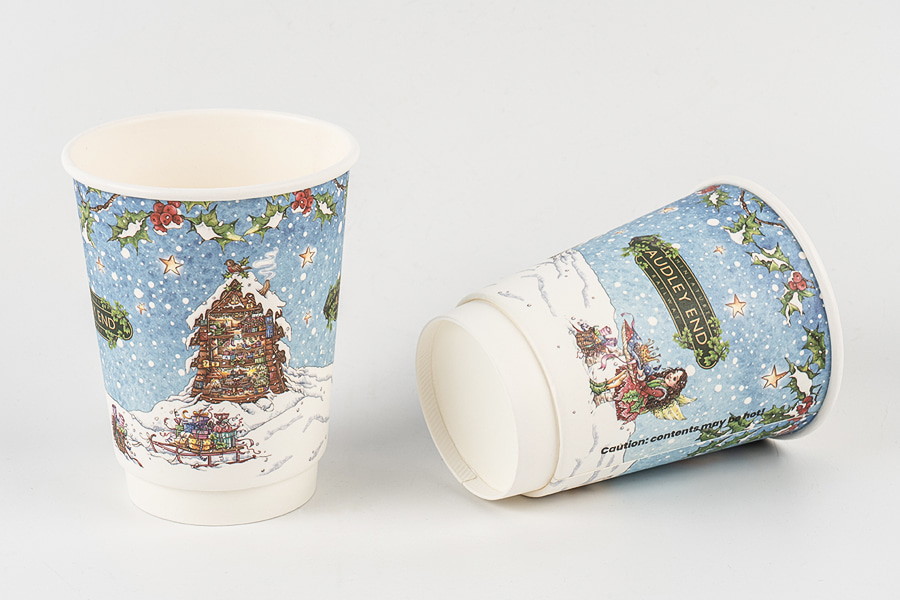
Custom printed double wall paper cups are the dominant format for branded coffee shop operators, hotel hospitality programs, and corporate catering. The outer wall of a double-wall cup provides an ideal print substrate — it is isolated from direct heat and moisture contact by the air gap, which means print inks and coatings remain visually stable and vibrant throughout the cup's service life in a way that single-wall outer surfaces often do not.
How Printing Affects Cup Strength
A correctly specified custom print program has negligible impact on structural strength. However, certain printing and finishing choices can affect performance if not properly controlled:
- Ink coverage and stiffness: Heavy solid ink coverage (above 70% area coverage) with thick UV-cured inks can slightly reduce outer wall flexibility, increasing brittleness in cold environments. Water-based inks used in flexographic printing do not exhibit this effect and are the preferred choice for structural neutrality.
- Varnish and over-laminate coatings: Gloss and matte varnishes applied to the outer wall surface are structurally inert but add approximately 2–4 gsm to the outer wall weight, contributing marginally to stiffness. UV-cured varnishes should be tested for adhesion at operating temperature ranges.
- Embossing or debossing: Decorative embossing patterns on the outer wall can locally reduce paperboard thickness by 5–15%, creating potential stress concentration points under high radial compression. For cups intended for high-temperature fills or physically demanding service environments, embossing depth should not exceed 0.3 mm.
Minimum Order Quantities and Lead Times for Custom Production
Custom printed double wall paper cups require a minimum order quantity (MOQ) that justifies the plate or sleeve setup costs for the printing process. Typical industry MOQs are:
- Flexographic printing: MOQ typically 10,000–25,000 cups per SKU. Setup involves printing plate production and is cost-effective for medium-to-high volume runs. Lead time: 4–6 weeks.
- Offset lithographic printing: MOQ typically 50,000+ cups. Highest print quality — suitable for photographic imagery and fine detail. Lead time: 5–8 weeks.
- Digital printing: MOQ as low as 500–2,000 cups. No plates required; ideal for short runs, seasonal designs, or event-specific branding. Lead time: 1–2 weeks. Some reduction in color gamut vs. litho.
Double-Wall Paper Cup Market Growth (2020–2026)
Demand for double-wall paper cups has grown consistently as the foodservice industry shifts away from polystyrene foam cups and sleeve-dependent single-wall formats. The chart below illustrates global market volume trends.
Figure 2: Eco-coated double-wall cups are the fastest-growing segment, with volume nearly tripling from 2021 to 2026 as regulatory pressure and consumer sustainability expectations accelerate the transition away from PE-lined formats.
Quality Standards and Testing for Double-Wall Paper Cups
Buyers procuring double wall paper cups for hot coffee at commercial scale should verify that products conform to applicable quality and safety standards. Key certifications and test criteria include:
- FDA 21 CFR (USA): All food-contact materials, including inner coatings and paperboard, must comply with FDA regulations for indirect food additives. Reputable manufacturers provide FDA compliance letters for their cup constructions.
- EU Regulation (EC) No 1935/2004: European food contact material framework requiring that materials do not transfer constituents to food in quantities that could endanger human health. Certificates of Compliance (CoC) should be provided.
- PEFC certification: For sustainably sourced paperboard fiber. Particularly relevant for operators making sustainability claims. Confirm the chain-of-custody certification extends to the cup manufacturer, not only the paper mill.
- EN 13432 compostability (for eco-lined cups): Verifies that the cup meets industrial compostability requirements — complete disintegration within 12 weeks and no ecotoxic residue. Applies to PLA and some mineral-coated formats.
- Compression strength testing (TAPPI T804): Standard test method for measuring radial compression resistance of cups. Request test reports showing results at both ambient temperature and after a 10-minute soak at 90°C to evaluate real-world service performance, not just ambient-condition values.
- Leakage and seal integrity testing: Verified by filling cups to rated capacity with water at 90°C and holding for 30 minutes in inverted or tilted positions. No leakage at the bottom seam or side seam within this test period is the acceptance criterion for commercial-grade cups.