English
 中文简体
中文简体What Are Double-Layer Paper Cups Used For?
Content
- 1 How the Double-Wall Structure Creates Superior Insulation
- 2 Primary Use Cases: Where Double-Layer Paper Cups Perform Best
- 3 Product Categories: Standard vs. Embossed/Ripple Wall Paper Cups
- 4 Custom Printed Paper Cups: Turning Packaging Into a Marketing Channel
- 5 Eco Friendly Coffee Cups: Sustainability Features and Environmental Credentials
- 6 Size Specifications and Volume Ranges for Commercial Buyers
- 7 Key Factors to Evaluate When Sourcing Double-Layer Paper Cups
- 8 About Ningbo Fenghua Yongfa Printing & Stationery Co., Ltd.
- 9 Frequently Asked Questions
Double-Layer Paper Cups are disposable beverage containers engineered with two concentric paper walls that trap an insulating air gap between them. This design allows users to safely hold hot drinks — coffee, milk tea, soup — without discomfort, while simultaneously keeping cold beverages chilled and condensation-free. They are the dominant packaging choice in coffee shops, bubble tea chains, convenience stores, offices, and hospitality settings worldwide, directly replacing the outdated single-walled cup as the industry standard for premium beverage service.
Whether you are sourcing Insulated Paper Coffee Cups for a high-volume cafe, evaluating Custom Printed Paper Cups to strengthen brand visibility, or seeking Eco Friendly Coffee Cups that align with your sustainability commitments, this guide covers all critical dimensions — market data, structural mechanics, product categories, environmental performance, and sourcing considerations — so you can make an informed decision.
Industry Adoption Rate of Double-Layer Paper Cups (Survey of 500+ Businesses)
Coffee shops show the highest adoption at nearly 9 in 10 businesses, reflecting the critical need for heat insulation in espresso and brewed coffee service. Bubble tea shops rank second, driven by both hot and iced drink formats that benefit from the dual-wall structure's versatility. The broad cross-industry uptake demonstrates that double-layer cups have transcended niche use to become a universal foodservice packaging staple.
How the Double-Wall Structure Creates Superior Insulation
The thermal performance of double-layer paper cups is rooted in physics: the air gap between the two paper walls behaves as an insulating barrier. Air is a poor conductor of heat — its thermal conductivity is approximately 0.025 W/m·K, compared to 0.05–0.08 W/m·K for paperboard alone. When hot liquid contacts the inner wall, heat attempts to conduct outward, but the air gap interrupts this transfer, keeping the outer surface touch-safe even when the contents exceed 85°C (185°F). Independent lab tests indicate that double-walled cups maintain a comfortable exterior temperature for 15–25 minutes longer than single-walled alternatives under equivalent fill conditions.
The structural advantage is equally significant. Single-walled cups frequently buckle under the weight and heat of full fills. The dual-paper construction in Disposable Hot Drink Cups distributes mechanical stress across both layers and the cavity between them, producing a noticeably stiffer, more reliable container — a quality particularly valued in larger-format cups (16 oz / 20 oz) common in takeaway coffee service.
Structural Layer Breakdown
| Layer | Material | Primary Function |
|---|---|---|
| Inner Wall | PE-coated food-grade paperboard | Liquid barrier & food safety |
| Air/Corrugated Gap | Trapped air or ripple paper | Thermal insulation & grip comfort |
| Outer Wall | Virgin or recycled paperboard | Structural rigidity & print surface |
| Bottom Disk | Laminated paperboard | Leak prevention & base stability |
Primary Use Cases: Where Double-Layer Paper Cups Perform Best
The versatility of double-layer paper cups makes them valuable across a wide spectrum of beverage service scenarios. Their thermal and structural properties are especially impactful in fast-paced, high-volume environments where handling speed, safety, and presentation all converge. Below are the core application categories where these cups deliver measurable advantages over single-walled alternatives.
- Specialty Coffee Service: Espresso-based drinks (lattes, cappuccinos, flat whites) served at 70–85°C demand a cup that protects baristas and customers from burns. Double-walled cups eliminate the need for corrugated sleeves, reducing material waste and assembly time.
- Bubble Tea & Milk Tea Chains: Both hot and iced milk teas benefit from the dual-wall design — hot versions stay safe to hold, while cold versions resist surface sweating, keeping counters and hands dry.
- Hot Soup & Noodle Packaging: Convenience stores and food courts increasingly use insulated paper cups for portion-served soups, congee, and instant noodle cups. The structural strength of double walls prevents collapse under liquid weight.
- Office & Corporate Catering: Meeting rooms, pantries, and catered events rely on disposable cups that look professional. Custom-printed double-walled cups serve a dual function: beverage delivery and brand communication.
- Seasonal Iced Beverages: Cold brew, iced lattes, smoothies, and slushies all benefit from the outer wall acting as a condensation barrier, maintaining a non-slip surface that customers can grip confidently.
- Events & Family Gatherings: For weddings, outdoor festivals, and private celebrations, disposable double-walled cups offer the practicality of disposables with a premium tactile feel that elevates the guest experience.
Beverage Temperature Retention Over 30 Minutes (°C)
The column chart illustrates beverage temperature retention over a 30-minute period for double-wall versus single-wall paper cups, starting at 85°C. Double-walled cups consistently maintain higher temperatures throughout the observation window, with a difference of approximately 12–18°C at the 30-minute mark. This performance gap is significant in commercial settings where takeaway customers may not consume their drink immediately after purchase.
Product Categories: Standard vs. Embossed/Ripple Wall Paper Cups
Not all double-layer cups are built identically. The market offers two principal variants — standard smooth double-walled cups and embossed or ripple wall versions — each with distinct aesthetic and functional profiles. Selecting the right type depends on your service environment, target customer demographic, and branding objectives.
Standard Double-Walled Cups
Standard double-walled cups feature a smooth outer surface that provides an excellent canvas for high-resolution CMYK printing. They are the workhorse of the industry — compatible with most cup-sleeve lids and dispensers, cost-efficient to manufacture at scale, and available in the full standard size range from 4 oz (espresso) to 22 oz (large iced drinks). Their clean, minimalist aesthetic suits premium coffee brands and corporate environments that prioritize a polished presentation.
Embossed / Dotted Double-Walled Cups (Ripple Wall Paper Cups)
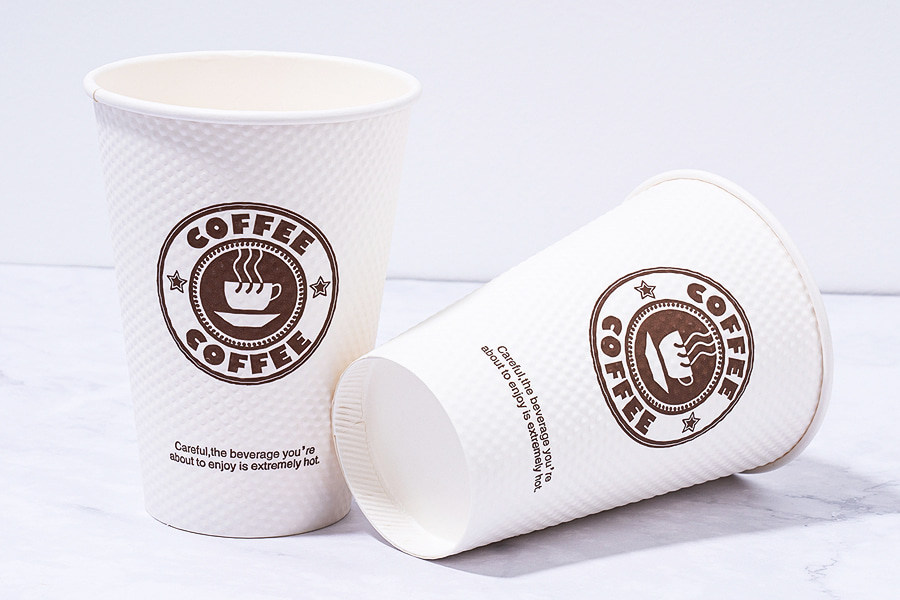
Ripple Wall Paper Cups — also called embossed or dotted double-walled cups — incorporate a textured corrugated or raised-pattern outer layer. This design serves both aesthetic and functional purposes: the raised surface increases the air gap for enhanced insulation, and the tactile texture provides superior grip even with wet or oily hands. They are particularly popular in artisan coffee shops and specialty beverage brands that want to differentiate their cup from commodity packaging. The embossed pattern also adds visual texture that photographs well for social media marketing — a factor increasingly considered by modern food and beverage brands.
| Feature | Standard Double-Walled | Embossed / Ripple Wall |
|---|---|---|
| Outer Surface | Smooth | Textured / Raised pattern |
| Insulation Level | High | Very High |
| Grip Comfort | Good | Excellent |
| Print Area | Full outer surface | Partial (between ridges) |
| Visual Appeal | Clean, minimal | Artisan, premium |
| Best Suited For | Branded chains, corporate | Specialty cafes, boutique brands |
Custom Printed Paper Cups: Turning Packaging Into a Marketing Channel
A paper cup is not merely a container — it is a mobile billboard that travels from your counter to the street, the office, the park, and social media feeds. Custom Printed Paper Cups have emerged as one of the highest-ROI brand touchpoints available to food and beverage businesses. Research by the Paper Cup Alliance indicates that a single custom cup can generate between 500 and 1,500 brand impressions throughout its lifecycle, particularly in urban takeaway environments where customers carry drinks in public spaces.
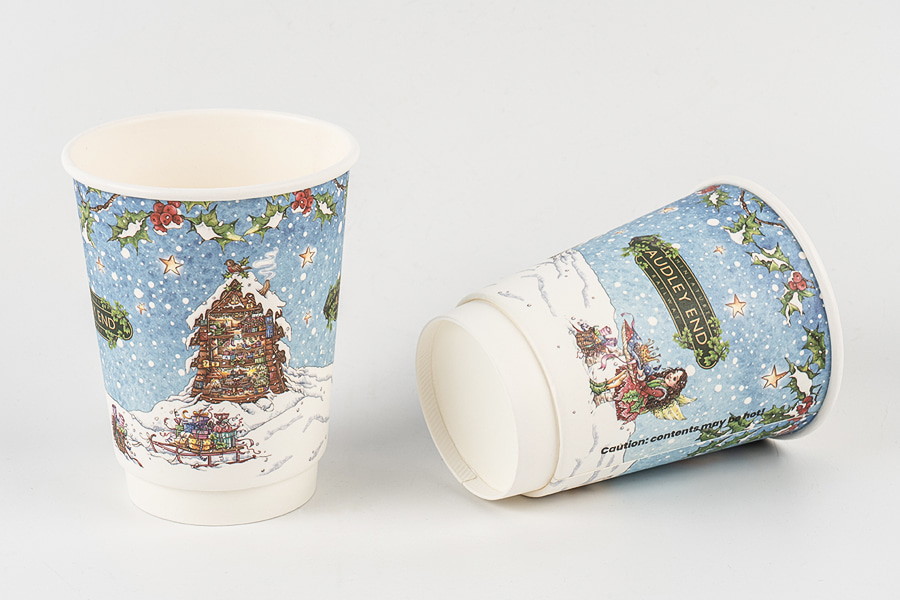
Modern printing technology — including CMYK Heidelberg offset presses and digital print processes — enables photographic-quality imagery, Pantone color matching, and fine-detail typography on the curved surface of a paper cup. Businesses can incorporate logos, seasonal campaigns, QR codes linking to loyalty programs, and social handles — all on a single cup. The smooth outer surface of standard double-walled cups is especially receptive to full-bleed printing, allowing brands to cover the entire visible surface area with vivid, consistent color.
Global Disposable Paper Cup Market Size (USD Billion, 2018–2028F)
The global disposable paper cup market has demonstrated consistent growth from an estimated USD 9.2 billion in 2018, with projections indicating it could approach USD 19.8 billion by 2028, representing a CAGR of approximately 7.9%. Growth is driven by the expansion of cafe culture across Asia-Pacific, increasing consumer preference for on-the-go beverage formats, and the ongoing migration from plastic cups to paper-based alternatives. The 2020 dip reflects pandemic-era disruptions to food service, followed by a strong recovery trajectory from 2021 onward.
Eco Friendly Coffee Cups: Sustainability Features and Environmental Credentials
Environmental responsibility has become a purchasing criterion, not just a marketing claim. Modern Eco Friendly Coffee Cups in the double-walled category have evolved substantially — manufacturers now offer PLA (polylactic acid) lining alternatives to traditional polyethylene coatings, enabling full composability in industrial compost facilities. Cups made with paperboard guarantee that source fibers are harvested from responsibly managed forests. Some suppliers offer cups with soy-based or water-based inks that reduce volatile organic compound (VOC) emissions compared to traditional solvent-based printing.
From a practical standpoint, double-walled cups already have an inherent sustainability advantage over single-walled cups with attached sleeves: they eliminate a secondary packaging component entirely. A customer receiving a hot coffee in a double-walled cup has one item to dispose of instead of two, reducing material throughput at both the production and waste-handling stage. For businesses pursuing zero-waste certifications or participating in extended producer responsibility (EPR) schemes, this simplification is operationally significant.
Performance Radar: Double-Wall vs. Single-Wall vs. Plastic Cup
The radar chart compares three cup types across six performance dimensions: Insulation, Print Quality, Rigidity, Cost Efficiency, Grip, and Eco-Score. Double-walled paper cups lead significantly in Insulation and Grip, while maintaining competitive scores across all other dimensions. Plastic cups score poorly on Eco-Score despite their rigidity advantage, and single-walled cups trade performance for lower unit cost — a trade-off that many businesses find unsatisfactory given rising consumer expectations for product quality and sustainability.
Size Specifications and Volume Ranges for Commercial Buyers
Selecting the correct cup size is as critical as selecting the material. An undersized cup creates customer dissatisfaction; an oversized cup wastes material and distorts drink proportions. The following table outlines the standard size range for Disposable Hot Drink Cups in the double-walled format, with typical application contexts.
| Size (oz) | Volume (ml) | Common Applications | Market Share (%) |
|---|---|---|---|
| 4 oz | 120 ml | Espresso shots, tasting samples | 6% |
| 8 oz | 240 ml | Short coffee, small milk tea | 22% |
| 12 oz | 355 ml | Medium latte, standard tea | 31% |
| 16 oz | 473 ml | Large coffee, iced drinks, bubble tea | 28% |
| 20–22 oz | 590–650 ml | Extra-large, event catering, hot soup | 13% |
Double-Wall Paper Cup Demand by Size (% of Commercial Orders)
The 12 oz size commands the largest share of commercial orders at 31%, reflecting its fit with standard medium latte and milk tea portions globally. The 16 oz format closely follows at 28%, driven by the growing popularity of large iced beverages, particularly in Asian markets where bubble tea servings trend larger. Together, 12 oz and 16 oz account for nearly 60% of all double-walled cup orders, making them the most important sizes for any supplier's inventory planning.
Key Factors to Evaluate When Sourcing Double-Layer Paper Cups
Procurement decisions for disposable cup products involve more variables than unit cost alone. Below are the critical dimensions that experienced buyers consistently evaluate when qualifying cup suppliers for long-term contracts.
- Food Safety Certification: Confirm that cups comply with FDA (US), EU food contact material regulations, or SGS standards depending on your target market. Inner PE or PLA coatings must be certified food-safe and free from BPA, heavy metals, and fluorescent whitening agents.
- GSM (Paperboard Weight): The grammage of the paperboard directly affects rigidity and insulation. Industry-standard double-walled cups typically use 170–250 GSM for the outer wall and 140–190 GSM for the inner wall. Lighter grammage saves cost but may compromise structural performance at full fill.
- Minimum Order Quantity (MOQ) and Lead Times: Custom-printed cups generally carry MOQs of 10,000–50,000 units per SKU. Evaluate whether your supplier can accommodate seasonal demand fluctuations with reasonable lead times of 15–30 days for stock items and 30–45 days for custom orders.
- Printing Technology: CMYK offset printing on Heidelberg presses delivers the most consistent color accuracy and resolution for full-coverage branding. Confirm that the supplier's print color calibration process matches your brand color specifications precisely.
- Stacking and Storage Efficiency: Cups should be designed for stable stacking at a 1:8 taper ratio minimum to maximize storage density in back-of-house environments. Poorly tapered cups collapse in dispensers and cause service delays.
- Environmental Claims Verification: If sourcing eco-certified cups, request third-party documentation for FSC fiber certification, PLA compostability certification (EN 13432 or ASTM D6400), or recycled content percentage claims. Unsubstantiated environmental claims carry reputational and regulatory risk.
About Ningbo Fenghua Yongfa Printing & Stationery Co., Ltd.
Double-walled paper cups are disposable containers optimized for both hot and cold beverages. Thanks to the superior insulation and stability provided by their double-walled structure, they have become a mainstream packaging choice for drinks such as coffee, milk tea, hot soup, and iced beverages. They are widely used in chain tea shops, coffee shops, convenience stores, offices, and family gatherings. They solve the problem of single-walled paper cups being too hot or too cold to hold, while also improving the feel and safety during use. Compared to ordinary single-walled paper cups, their core advantage lies in the "air insulation layer" formed by the gap between the two layers of paper, which also strengthens the cup's rigidity, balancing practicality and user experience.
Ningbo Fenghua Yongfa Printing & Stationery Co., Ltd. was founded in 2003 and is located in Ningbo, Zhejiang Province, China. We specialize in paper printing, party items, and packaging items manufacturing. Our factory covers an area of 9,000 square meters and employs over 100 staff, more than 70% of whom have over 10 years of working experience.
The plant is equipped with CMYK automatic Heidelberg printing machines, die-cutting machines, corrugated machines, and dozens of paper cup and paper plate forming machines. Our main products include paper cups, paper plates, napkin package boxes, cards, bags, and other paper items. We have been a Gold Supplier on Alibaba since 2007 and hold relevant certificates such as SGS, FDA, and EU standards.
Frequently Asked Questions
Q1: What is the difference between a double-wall paper cup and a ripple wall paper cup?
A double-wall paper cup uses two smooth paper layers with a flat air gap for insulation. A ripple wall paper cup (also called an embossed or dotted cup) has a corrugated or raised-pattern outer layer that increases the effective air gap depth, providing slightly higher insulation and a more pronounced tactile grip. Both eliminate the need for a separate cardboard sleeve.
Q2: Are double-layer paper cups suitable for cold drinks and iced beverages?
Yes. The air gap in double-walled cups works for cold drinks just as effectively as for hot ones. It slows heat transfer from the surrounding environment into the beverage, helps maintain chill temperature, and — critically — prevents condensation from forming on the outer wall. This keeps the cup dry and non-slip even when filled with iced drinks on a humid day.
Q3: What is the minimum order quantity for custom printed double-wall paper cups?
MOQs vary by supplier and cup size, but a typical range for custom-printed double-walled cups is 10,000 to 50,000 units per design per size. For multi-SKU orders that combine several sizes under a single brand design, some manufacturers offer consolidated MOQs. It is advisable to confirm artwork lead times (usually 7–10 business days for proofing) separately from production lead times.
Q4: Are double-wall paper cups recyclable or compostable?
Standard double-walled cups with PE lining are technically recyclable in facilities equipped to separate the plastic film from the fiber, though this infrastructure is not universally available. Cups with PLA (plant-based) lining are industrially compostable under EN 13432 or ASTM D6400 certification, meaning they break down in commercial composting environments — not home compost. Always verify the cup's lining material and corresponding certification before making environmental claims.
Q5: Can double-wall paper cups be used in microwave ovens?
Generally, no. The PE or PLA inner lining and the paper construction are not designed for microwave use. High microwave temperatures can degrade the lining material, potentially allowing liquid penetration, and can cause uneven heating that weakens the cup structure. For reheating beverages in paper cups, it is recommended to transfer the contents to a microwave-safe container.
Q6: What certifications should I look for when sourcing insulated paper coffee cups for export markets?
For the US market, FDA food contact material compliance is essential. For the European Union, cups must meet EC 1935/2004 (food contact materials) and relevant specific migration limits. SGS testing certification covers a broad range of chemical safety tests. If exporting to markets with strict single-use plastics regulations, also confirm whether PE or PLA lining aligns with local legislative requirements, as this is an evolving regulatory landscape.