English
 中文简体
中文简体Is Disposable Paper Tableware Safe for Hot Food?
Content
- 1 What Makes Disposable Paper Tableware Safe for Hot Food?
- 2 Temperature Performance: What the Data Shows
- 3 The Rise of Eco Friendly Disposable Tableware
- 4 Custom Printed Paper Tableware: Safety Considerations for Branding
- 5 How to Evaluate a Paper Tableware Supplier
- 6 Common Misconceptions About Paper Tableware and Heat
- 7 About Ningbo Fenghua Yongfa Printing & Stationery Co., Ltd.
- 8 Frequently Asked Questions
Yes — disposable paper tableware is safe for hot food when it is manufactured with food-grade materials and appropriate coatings. Modern paper cups, plates, and bowls are engineered to withstand temperatures up to 100°C (212°F) without leaching harmful chemicals, provided they meet FDA, EU, or equivalent safety standards. That said, not all paper tableware is created equal. Understanding what makes a product safe — and what to look for — is essential for both consumers and businesses.
What Makes Disposable Paper Tableware Safe for Hot Food?
The safety of paper tableware for hot food depends primarily on three factors: the base material, the coating or lining, and the manufacturing process. Most reputable disposable paper tableware uses a thin layer of PE (polyethylene) or PLA (polylactic acid) to create a moisture and heat barrier.
Key Safety Features to Look For
- Food-grade virgin paper pulp (not recycled fiber for food contact surfaces)
- FDA-approved or EU-compliant coatings that resist heat and moisture
- Inks and dyes that are certified food-safe and non-toxic
- Verified absence of PFAS (per- and polyfluoroalkyl substances), also called "forever chemicals"
- SGS certification or equivalent third-party testing
Products that carry SGS, FDA, and EU certifications have passed rigorous independent testing for migration of harmful substances into food and beverages — even at high temperatures.
Temperature Performance: What the Data Shows
Standard single-wall paper cups are rated for liquids up to 88°C (190°F), while double-wall or ripple-wall cups maintain structural integrity at up to 100°C (212°F). Paper plates designed for hot food typically withstand oven reheating at temperatures below 120°C (248°F) for short durations. Below is a comparison of common paper tableware types and their heat tolerance:
| Product Type | Max Safe Temp | Suitable For | Microwave Safe |
|---|---|---|---|
| Single-wall paper cup | 88°C / 190°F | Coffee, tea, hot drinks | No |
| Double-wall paper cup | 100°C / 212°F | Boiling beverages, soups | No |
| Paper plate (PE-coated) | 100°C / 212°F | Hot meals, BBQ, buffets | Check label |
| Paper bowl (PLA-lined) | 85°C / 185°F | Soups, noodles, stews | No |
| Uncoated paper plate | Dry heat only | Dry snacks, pastries | No |
Cup
Cup
(PE-coated)
(PLA-lined)
Plate
The Rise of Eco Friendly Disposable Tableware
Consumer demand for sustainability has driven significant growth in eco friendly disposable tableware. The global paper tableware market was valued at over $5.8 billion in 2023 and is projected to grow at a CAGR of approximately 4.5% through 2030, largely fueled by the shift away from single-use plastics.
PLA-coated paper products are particularly popular because PLA is derived from renewable plant sources such as corn starch. Unlike traditional PE coatings, PLA-lined tableware can be composted in industrial facilities, making it a more environmentally responsible choice for catering, events, and foodservice businesses.
Eco Credentials Worth Looking For
- Paper — ensures sustainable forest sourcing
- Compostable certification (e.g., EN 13432 in Europe, ASTM D6400 in the US)
- Soy-based or water-based inks for printed surfaces
- PFAS-free grease barriers — many manufacturers now offer plant-derived alternatives
Choosing eco friendly disposable tableware that is also food-safe does not require compromise. Many PLA-coated and water-based-coated products now match or exceed the heat resistance of conventional PE-coated alternatives.
Custom Printed Paper Tableware: Safety Considerations for Branding
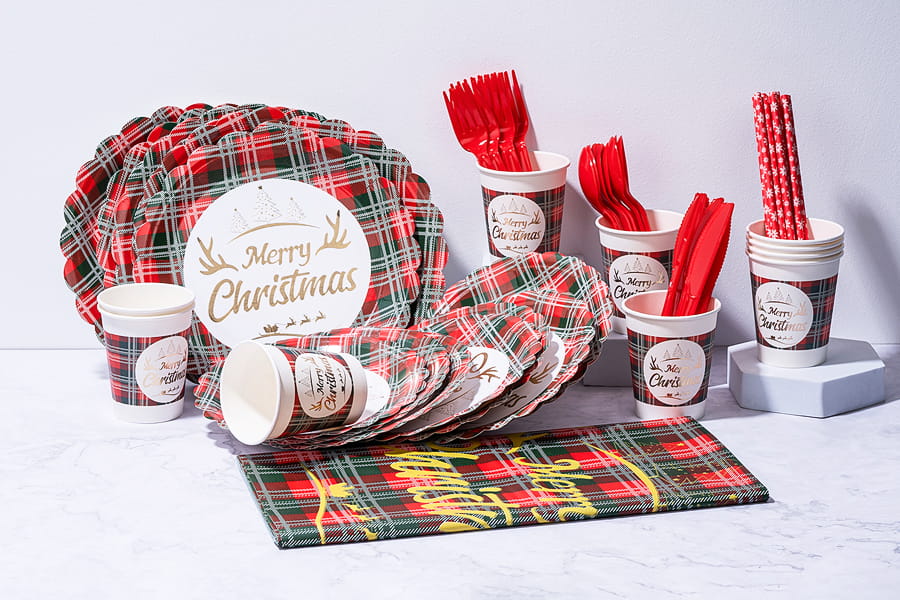
Custom printed paper tableware is widely used by cafes, restaurants, event planners, and food brands to reinforce identity. However, printing on food-contact surfaces introduces additional safety considerations. All inks used on the food-contact side must be certified food-safe, and printing on external surfaces only — not the inner food-contact area — is standard practice.
Best Practices for Custom Printed Paper Tableware
- Request a material safety data sheet (MSDS) from the manufacturer for all inks and coatings used.
- Specify that printing must be on the outer surface only for cups and bowls.
- Confirm that the supplier holds FDA and/or EU food contact material certifications.
- Use CMYK offset or flexographic printing with food-safe inks — avoid UV inks on food-contact areas.
- Request pre-production samples for quality verification before bulk orders.
Manufacturers equipped with CMYK automatic Heidelberg printing machines can deliver high-resolution, color-accurate custom prints that meet strict food safety standards while producing professional, branded results.
How to Evaluate a Paper Tableware Supplier
When sourcing disposable paper tableware — whether for a restaurant chain, event company, or retail distribution — supplier credibility is as important as product specs. Here is a practical checklist:
- Third-party certifications: SGS, FDA, EU food contact standards — not self-declared compliance
- Production capacity: Large-scale facilities with dedicated paper cup and plate forming machines ensure consistency
- OEM/ODM capabilities: Ability to handle custom shapes, sizes, and branding
- Experience: Suppliers with 10+ years of verified export history tend to have more stable quality control
- Verified trade platforms: Verified Gold Supplier status on major B2B platforms adds an additional layer of credibility
Common Misconceptions About Paper Tableware and Heat
Several myths persist around the safety of paper tableware with hot food. Here are the most important ones addressed directly:
Myth 1: The Coating Always Melts Into Your Drink
PE-coated cups only begin to soften above 120-130°C, well above the boiling point of water. Under normal use, migration into beverages is negligible and within internationally accepted food safety limits. Third-party lab testing (such as SGS migration tests) confirms this.
Myth 2: All Recycled Paper Tableware Is Eco-Friendly and Safe
Recycled paper can contain mineral oils and other contaminants from printing inks in previous uses. Food-grade virgin paper pulp is standard for the food-contact layer of certified disposable paper tableware, even in otherwise recycled products.
Myth 3: Paper Plates Are Safe in Any Microwave
Only paper plates explicitly labeled as microwave-safe should be used in a microwave. Plates with metallic inks or decorative foil elements must never be microwaved. Always check the product label before use.
About Ningbo Fenghua Yongfa Printing & Stationery Co., Ltd.
Ningbo Fenghua Yongfa Printing & Stationery Co., Ltd. was founded in 2003 and is located in Ningbo, Zhejiang Province, China. We specialize in paper printing, party items, and packaging items manufacturing. Our factory covers an area of 9,000 square meters and employs over 100 staff, more than 70% of whom have over 10 years of working experience.
The plant is equipped with CMYK automatic Heidelberg printing machines, die-cutting machines, corrugated machines, and dozens of paper cup and paper plate forming machines. Our main products include paper cups, paper plates, napkin package boxes, cards, bags, and other paper items. We have been a Gold Supplier on Alibaba since 2007 and hold relevant certificates such as SGS, FDA, and EU standards.
Ningbo Fenghua Yongfa Printing & Stationery Co., Ltd. is a professional OEM Disposable Paper Tableware Manufacturer and ODM Disposable Paper Tableware Factory in China, offering full customization services for global clients.